19 October 2019

Chapter 5 - Industry and Competitor Analysis

Industry Analysis
There are three major questions that have to be answered. First, is it a realistic place for a new venture to enter? Second, does the industry contain markets that are ripe for innovation or are underserved? Third, are there positions in the industry that will avoid some of the negative attributes of the industry as a whole?

Studying Industry Trends
Environmental and business trends are the two most important trends for entrepreneurs to evaluate.

1. Environmental Trends
Economic trends, social trends, technological advances, and political and regulatory changes are the most important environmental trends for entrepreneurs to study.

2. Business Trends
In a similar fashion, the firms in some industries are able to move customer procurement and service functions online, at considerable cost savings, while the firms in other industries aren’t able to capture this advantage. Trends such as these favor some industries over others.

The Five Forces Model
Professor Michael Porter developed this important tool. Each of Porter’s five forces affects the average rate of return for the firms in an industry by applying pressure on industry profitability.

Porter points out that industry profitability is not a function of only a product’s features. Porter’s essential points still offer important insights for entrepreneurs such as the insight suggested by the following quote:

"Industry profitability is not a function of what the product looks like or whether it embodies high or low technology but of industry structure. Some very mundane industries such as postage meters and grain trading are extremely profitable, while some more glamorous, high-technology industries such as personal computers and cable television are not profitable for many participants."

A. Threat of Substitutes
Industries are more attractive when the threat of substitutes is low.
This means that products or services from other industries can’t easily serve as substitutes for the products or services being made and sold in the focal firm’s industry.
Products or services from other industries can’t easily serve as substitutes for the products or services being made and sold in the focal firm’s industry.

B. Threat of New Entrants
Industries are more attractive when the threat of entry is low. This means that competitors cannot easily enter the industry and successfully copy what the industry incumbents are doing to generate profits.
There are a number of ways that firms in an industry can keep the number of new entrants low. These techniques are referred to as barriers to entry. A barrier to entry is a condition that creates a disincentive for a new firm to enter an industry. Let’s look at the six major sources of barriers to entry:

1. Economies of scale
Economies of scale occur when mass-producing a product results in lower average costs.

2. Product differentiation
Product innovation is another way a firm can differentiate its good or service from competitors’ offerings.

3. Capital requirements
The need to invest large amounts of money to gain entrance to an industry is another barrier to entry.

4. Cost advantages independent of size
Entrenched competitors may have cost advantages not related to size that are not available to new entrants.

5. Access to distribution channels
Distribution channels are often hard to crack. This is particularly true in crowded markets, such as the convenience store market.

6. Government and legal barriers
In knowledge-intensive industries, patents, trademarks, and copyrights form major barriers to entry.

When start-ups create their own industries or create new niche markets within existing industries, they must create barriers to entry of their own to reduce the threat of new entrants.

C. Rivalry Among Existing Firm
In most industries, the major determinant of industry profitability is the level of competition among the firms already competing in the industry. Some industries are fiercely competitive to the point where prices are pushed below the level of costs.

1. Number and balance of competitors
With a larger number of competitors, it is more likely that one or more will try to gain customers by cutting prices.

2. Degree of difference between products
The degree to which products differ from one producer to another affects industry rivalry. 

3. The growth rate of an industry
The competition among firms in a slow-growth industry is stronger than among those in fast-growth industries. Slow-growth industry firms must fight for market share, which may tempt them to lower prices or increase quality to obtain customers. In fast-growth industries there are enough customers to satisfy most firms’ production capacity, making price-cutting less likely.

4. Level of fixed costs
Firms that have high fixed costs must sell a higher volume of their product to reach the break-even point than firms with low fixed costs.

D. Bargaining Power of Suppliers
In general, industries are more attractive when the bargaining power of suppliers is low.
In some cases, suppliers can suppress the profitability of the industries to which they sell by raising prices or reducing the quality of the components they provide. If a supplier reduces the quality of the components it supplies, the quality of the finished product will suffer, and the manufacturer will eventually have to lower its price.

1. Supplier concentration
When there are only a few suppliers to provide a critical product to a large number of buyers, the supplier has an advantage.

2. Switching costs
Switching costs are the fixed costs that buyers encounter when switching or changing from one supplier to another. If switching costs are high, a buyer will be less likely to switch suppliers.

3. Attractiveness of substitutes
Supplier power is enhanced if there are no attractive substitutes for the products or services the supplier offers.

4. The threat of forwarding integration
The power of a supplier is enhanced if there is a credible possibility that the supplier might enter the buyer’s industry.

E. Bargaining Power of Buyers
In general, industries are more attractive when the bargaining power of buyers (a start-up’s customers) is low. Buyers can suppress the profitability of the industries from which they purchase by demanding price concessions or increases in quality.

1. Buyer group concentration
Meaning that there are only a few large buyers, and they buy from a large number of suppliers, they can pressure the suppliers to lower costs and thus affect the profitability of the industries from which they buy.

2. Buyer’s costs
The greater the importance of an item is to a buyer, the more sensitive the buyer will be to the price it pays.

3. Degree of standardization of supplier’s products
The degree to which a supplier’s product differs from its competitors’ offering affects the buyer’s bargaining power.

4. The threat of backward integration
The power of a buyer is enhanced if there is a credible threat that the buyer might enter the supplier’s industry.

The Value of the Five Forces Model
The five forces model can be used in two ways:
First, to help a firm determine whether it should enter a particular industry.
Second, whether it can carve out an attractive position in that industry.


Industry Types and the Opportunities They Offer
It is helpful for a new venture to study industry types to determine the opportunities they offer.

A. Emerging Industries
Recent changes in demand or technology; the new industry standard operating procedures have yet to be developed.

B. Fragmented Industries
A large number of firms of approximately equal size.

C. Mature Industries
Slow increases in demand, numerous repeat customers, and limited product innovation

D. Declining Industries
Consistent reduction in industry demand

E. Global Industries
Significant international sales

Competitor Analysis
Competitor analysis is a detailed analysis of a firm’s competition. It helps a firm understand the positions of its major competitors and the opportunities that are available to obtain a competitive advantage in one or more areas.

A. Identifying Competitors
The first step in the competitive analysis is to determine who the competition is.

1. Direct competitors
Businesses that offer products or services that are identical or highly similar

2. Indirect competitors
These competitors offer close substitutes to the product

3. Future competitors
These are companies that are not yet direct or indirect competitors but could move into one of these roles at any time.

B. Sources of Competitive Intelligence
A firm must first understand the strategies and behaviors of its competitors. The information that is gathered by a firm to learn about its competitors is called competitive intelligence (The information that is gathered by a firm to learn about its competitors).
The sources of competitive intelligence are:

  • Attend conferences and trade shows
  • Purchase competitors’ products
  • Study competitors’ websites and social media pages
  • Set up Google e-mail alerts
  • Read industry-related books, magazines, websites, and blogs
  • Talk to customers about what motivated them to buy your product as opposed to your competitor’s product

01 October 2019

Chapter 4 - Developing an Effective Business Model

Business Models and Their Importance
A firm’s business model is its plan or recipe for how it creates, delivers, and captures value for its stakeholders.

General Categories of Business Models

There are two general categories of business models: standard business models and disruptive business models.

A. Standard Business Models


Standard business models depict existing plans or recipes firms can use to determine how they will create, deliver, and capture value for their stakeholders.


B. Disruptive Business Models

Disruptive business models, are rare, are ones that do not fit the profile of a standard business model and are impactful enough that they disrupt or change the way business is conducted in an industry or an important niche within an industry. There are two types of disruptive business models.

1. Newmarket disruption
Addresses a market that previously wasn’t served.

2. Low-end market disruption
Possible when the firms in the industry continue to improve products or services to the point where they are actually better than a sizable portion of their clientele needs or desires. This “performance oversupply” creates a vacuum that provides an opportunity for simple, typically low-cost business models to exist.

The Barringer/Ireland Business Model Template
Although not everyone agrees precisely on the components of a business model, many agree that a successful business model has a common set of attributes. These attributes are often laid out in a visual framework or template so it is easy to see the individual parts and their interrelationships. One widely-used framework is the Business Model Canvas, popularized by Alexander Osterwalder and Yves Pigneur in their book, Business Model Generation. The Business Model Canvas consists of nine basic parts that show the logic of how a firm intends to create, deliver, and capture value for its stakeholders.

The Barringer/Ireland Business Model Template is slightly more comprehensive than the Business Model Canvas in that it consists of 4 major categories and 12 individual parts. The 12 parts make up a firm’s business model.


A. Core Strategy

A core strategy describes how the firm plans to compete relative to its competitors.

1. Business Mission

A business’s mission or mission statement describes why it exists and what its business model is supposed to accomplish. If carefully written and used properly, a mission statement can articulate a business’s overarching priorities and act as its financial and moral compass. A firm’s mission is the first box that should be completed in the business model template. A well-written mission statement is something that a business can continually refer back to as it makes important decisions in other elements of its business model.

A business’s mission statement should:

  • Define its “reason for being”
  • Describe what makes the company different
  • Be risky and challenging but achievable
  • Use a tone that represents the company’s culture and values
  • Convey passion and stick in the mind of the reader
  • Be honest and not claim to be something that the company “isn’t”

2. Basis of Differentiation
A company’s basis of differentiation is what causes consumers to pick one company’s products over another’s. It is what solves a problem or satisfies a customer's needs. When completing the basis for the differentiation portion of the Barringer/Ireland Business Model Template, it’s best to limit the description to two to three points.

3. Target Market
target market is a place within a larger market segment that represents a narrower group of customers with similar interests. Most new businesses do not start by selling to broad markets. Instead, most start by identifying an emerging or underserved niche within a larger market.

4. Product/Market Scope

A company’s product/market scope defines the products and markets on which it will concentrate. Most firms start narrow and pursue adjacent product and market opportunities as the company grows and becomes financially secure.

B. Resources

Resources are the inputs a firm uses to produce, sell, distribute, and service a product or service.

1. Core Competencies

A core competency is a specific factor or capability that supports a firm’s business model and sets it apart from its rivals. A core competency can take on various forms, such as technical know-how, an efficient process, a trusting relationship with customers, expertise in product design, and so forth. It may also include factors such as a passion for a business idea and a high level of employee morale. A firm’s core competencies largely determine what it can do.
Most start-ups will list two to three core competencies on the business model template. Consistent with the information provided above, a core competency is compelling if it not only supports a firm’s initiatives but is also difficult to imitate and substitute. Few start-ups have core competencies in more than two to three areas.

2. Key Assets

Key assets are the assets that a firm owns that enable its business model to work. The assets can be physical, financial, intellectual, or human.
  • Physical assets include physical space, equipment, vehicles, and distribution networks.
  • Intellectual assets include resources such as patents, trademarks, copyrights, and trade secrets, along with a company’s brand and its reputation.
  • Financial assets include cash, lines of credit, and commitments from investors.
  • Human assets include a company’s founder or founders, its key employees, and its advisors.

C. Financials

This is the only section of a firm’s business model that describes how it earns money. For most businesses, the manner in which it makes money is one of the most fundamental aspects around which its business model is built. The primary aspects of financials are revenue streams, cost structure, and financing/funding.

1. Revenue Streams

A firm’s revenue streams describe the ways in which it makes money. Some businesses have a single revenue stream, while others have several.


2. Cost Structure
A business’s cost structure describes the most important costs incurred to support its business model. Generally, the goal for this box in a firm’s business model template is threefold: identify whether the business is a cost-driven or value-driven business, identify the nature of the business’s costs (fixed costs and variable costs), and identify the business’s major cost categories.

Businesses can be categorized as cost-driven or value-driven.
  • Cost-driven businesses focus on minimizing costs wherever possible.
  • Value-driven business models focus on offering a high-quality product (or experience) and personalized service.
  • Fixed costs are costs that remain the same despite the volume of goods or services provided.
  • Variable costs vary proportionally with the volume of goods or services produced.
  • Business's major cost helps a business understand where its major costs will be incurred.

3. Financing/Funding
Finally, many business models rely on a certain amount of financing or funding to bring their business model to life.
In these cases, the business model template should indicate the approximate amount of funding that will be needed and where the money is most likely to come from.
There are three categories of costs to consider: capital costs, one-time expenses, and provisions for ramp-up expenses.
  • Capital costs include real estate, buildings, equipment, vehicles, furniture, fixtures, and similar capital purchases.
  • one-time expenses such as legal expenses to launch the business, website design, procurement of initial inventory, and similar one-time expenses and fees.
  • ramp-up expenses are where they lose money until they are fully up to speed and reach profitability.

D. Operations
Operations are both integral to a firm’s overall business model and represent the day-to-day heartbeat of a firm. The primary elements of operations are product (or service) production, channels, and key partners.

1. Product (or Service) Production

This section focuses on how a firm’s products and/or services are produced.
If a firm sells physical products, the products can be manufactured or produced in-house, by a contract manufacturer, or via an outsource provider.
If a firm is providing a service rather than a physical product, a brief description of how the service will be produced should be provided.

2. Channels
A company’s channels describe how it delivers its product or service to its customers. Businesses sell direct, through intermediaries, or through a combination of both.
  • Sell Direct: Via company-owned stores or company-owned websites.
  • Through Intermediaries: Via distributors and wholesalers. Or using other company-owned websites/services (AliExpress, Amazon, Banggood, Tokopedia).

3. Key Partners

Start-ups, in particular, typically do not have sufficient resources (or funding) to perform all the tasks needed to make their business models work, so they rely on partners to perform key roles.

The first partnerships that many businesses forge are with suppliers. A supplier (or vendor) is a company that provides parts or services to another company. Almost all firms have suppliers who play vital roles in the functioning of their business models.


Along with suppliers, firms partner with other companies to make their business models work. The most common types of relationships, which include strategic alliances and joint ventures.


The advantages of participating in partnerships include: gaining access to a particular resource, risk and cost-sharing, speed to market, and learning.


Partnerships also have potential disadvantages.The disadvantages include loss of proprietary information, management complexities, and partial loss of decision autonomy.

Chapter 3 - Feasibility Analysis

Feasibility Analysis
Feasibility analysis is the process of determining if a business idea is viable. Feasibility analysis is investigative in nature and is designed to critique the merits of a proposed business.

According to John W. Mullins, failure to properly investigate the merits of a business idea before developing a business model and a business plan is written runs the risk of blinding an entrepreneur to inherent risks associated with the potential business and results in too positive of a plan.


Completing a feasibility analysis requires both primary and secondary research. Primary research is research that is collected by the person or persons completing the analysis. It normally includes talking to prospective customers, getting feedback from industry experts, conducting focus groups, and administering surveys. Secondary research probes data that is already collected. The data generally includes industry studies, Census Bureau data, analyst forecasts, and other pertinent information gleaned through library and Internet research.


Product/Service Feasibility Analysis

Product/service feasibility analysis is an assessment of the overall appeal of the product or service being proposed.
There are two components to product/service feasibility analysis: product/service desirability and product/service demand.

A. Product/Service Desirability

Product/service feasibility is to affirm that the proposed product or service is desirable and serves a need in the marketplace.

1. Concept Test

Involves showing a preliminary description of a product or service idea, called a concept statement, to industry experts and prospective customers to solicit their feedback.
Concept statement normally includes the following:
  • A description of the product or service.
  • The intended target market.
  • The benefits of the product or service.
  • A description of how the product or service will be positioned relative to competitors.
  • A brief description of the company’s management team.

B. Product/Service Demand
The second component of product/service feasibility analysis is to determine if there is a demand for the product or service. Three commonly utilized methods for doing this include talking face-to-face with potential customers, utilizing online tools, such as Google Adwords and landing pages, to assess demand, and library, Internet, and gumshoe research.

1. Talking Face-to-Face with Potential Customers

The only way to know if your product or service is what people want is by talking to them. One approach to finding qualified people to talk to about a product or service idea or to react to a concept statement is to contact trade associations and/or attend industry trade shows.

2. Utilizing Online Tools

Another common approach to assessing product demand is to use online tools, such as Google AdWords and landing pages (advertisement).

3. Library, Internet, and Gumshoe Research

The third way to assess demand for a product or service idea is by conducting a library, Internet, and gumshoe research. While talking to prospective customers is critical, collecting secondary data on the industry is also helpful.
Simple gumshoe research is also important for gaining a sense of the likely demand for a product or service idea. A gumshoe is a detective or an investigator that scrounges around for information or clues wherever they can be found.

Industry/Target Market Feasibility Analysis

Industry/target market feasibility is an assessment of the overall appeal of the industry and the target market for the product or service being proposed.

A. Industry Attractiveness

In general, the most attractive industries have the characteristics depicted below.
  • Are young rather than old
  • Are early rather than late in their life cycle
  • Are fragmented rather than concentrated
  • Are growing rather than shrinking
  • Are selling products or services that customers “must-have” rather than “want to have”
  • Are not crowded
  • Have high rather than low operating margins
  • Are not highly dependent on the historically low price of key raw material, like gasoline or flour, to remain profitable

B. Target Market Attractiveness

A target market is a place within a larger market segment that represents a narrower group of customers with similar needs.

Organizational Feasibility Analysis

Organizational feasibility analysis is conducted to determine whether a proposed business has sufficient management expertise, organizational competence, and resources to successfully launch.

A. Management Prowess

Two of the most important factors in this area are the passion that the solo entrepreneur or the management team has for the business idea and the extent to which the management team or solo entrepreneur understands the markets in which the firm will participate.

B. Resource Sufficiency

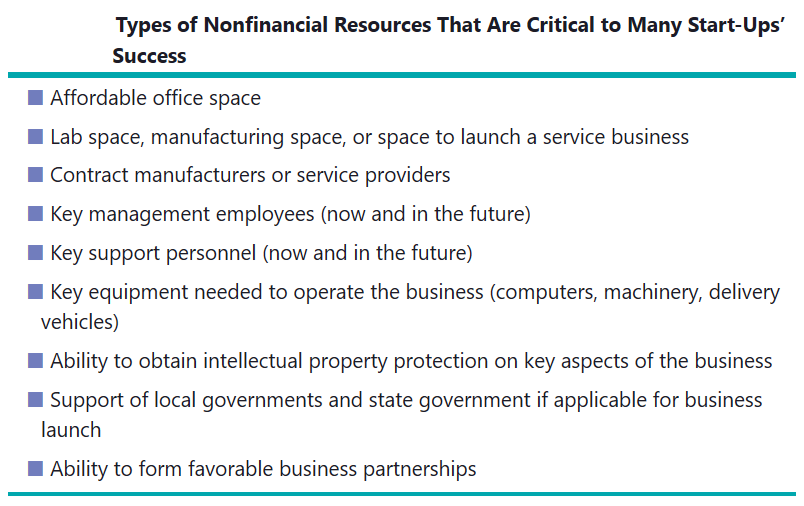
The second area of organizational feasibility analysis is to determine whether the proposed venture has or is capable of obtaining sufficient resources to move forward. The focus in organizational feasibility analysis is on nonfinancial resources. The objective is to identify the most important nonfinancial resources and assess their availability.

Financial Feasibility Analysis

Financial feasibility analysis is the final component of a comprehensive feasibility analysis. For feasibility analysis, a preliminary financial assessment is usually sufficient; indeed, additional rigor at this point is typically not required because the specifics of the business will inevitably evolve, making it impractical to spend a lot of time early on preparing detailed financial forecasts.

A. Total Start-Up Cash Needed

This first issue refers to the total cash needed to prepare the business to make its first sale. An actual budget should be prepared that lists all the anticipated capital purchases and operating expenses needed to get the business up and running.

Avoid cursory explanations such as “I plan to bring investors on board” or “I’ll borrow the money.”

Many new ventures look promising as ongoing concerns but have no way of raising the money to get started or are never able to recover from the initial costs involved. When projecting start-up expenses, it is better to overestimate rather than underestimate the costs involved.


B. Financial Performance of Similar Business
The second component of financial feasibility analysis is estimating a proposed start-up’s potential financial performance by comparing it to similar, already established businesses.

C. Overall Financial Attractiveness of the Proposed Venture

A number of other factors are associated with evaluating the financial attractiveness of a proposed venture. These evaluations are based primarily on a new venture’s projected sales and rate of return (or profitability), as just discussed.

A start-up’s projected rate of return should be weighed against the following factors to assess whether the venture is financially feasible:

  • The amount of capital invested
  • The risks assumed in launching the business
  • The existing alternatives for the money being invested
  • The existing alternatives for the entrepreneur’s time and efforts